Seasonal Stories of Soil, Sea, Sky, Home and Harmony
The Year Turn Fablist

English Folk Tales Retold

Story:
That's Enough to Go On With
A summer story of strawberries and sunshine, sharing and stealing.
Sun stretched and yawned. Slowly, with youthful glow and aging warmth, Sun made a new day. River glinted, shiny and bright, keen and eager as it rushed over Rock- slumbering. The green leaves of Beech and Ash gleamed and played with Sun, creating patterns of shadow and light. Breeze blew a warm kiss and Holly Blue Butterfly danced, dipping and dazzling. The trilling of the dawn chorus, filled the air. The songs of the early risers, Thrush and Blackbird, mingled with the sound of two children laughing and calling in the valley. With no parents or much money, they lived with their grandmother in a small cottage on the edge of the wood.
Their grandmother knew the old ways. People knew her as ‘Old Witch’ but she knew more- she knew which. She knew which berries to eat. Which broom would sweep. Which herbs would heal or dye. She knew the fox bark and the owl call. She knew where the stones stood and the where the water could fall. She knew mushrooms could kill- and she knew which wouldn’t and which would. She knew where to find the cool pool and the kindling wood. She knew to ask the Stars for directions and the Sun for the time. The Grandmother dressed herself according to the clouds and her cottage with the boughs. But most important of all she knew, she knew to be grateful.
The old woman welcomed every Dawn and thanked every Day. She gathered gratefully, appreciating each being for bearing their gifts. She respected with somber sanctity any sacrifice. And this gratitude, she taught her grandchildren. And despite their lack of possessions, their life was abundantly rich and full.
Now, that midsummer morning, the children were taking their goat to graze. They tumbled and argued, laughed and teased. They made their way to find their favourite tree to climb, Old Beech, with a hollow centre and a low branch. They took it in turns to hold the goat whilst the other scrambled up, the powdery core wood dusting their shoulders and knees. Scraping and heaving, the girl hauled herself higher and higher, calling down to show off how high she had reached. But climbing up is less daunting than climbing back down. Despite Beech providing gnarled, knotty footholds, the girl panicked and her shouts of triumph and pride became cries for help. Her brother, had been holding tight to the goat’s rope but when her realised his sister’s fear, he called up to help her and guide her back down. “I’ll climb up a bit and then you can stand on my shoulders!” he called, quickly tying the rope around a nearby branch. But oh no! Without the children noticing, the rope slipped and the goat ran off. Brushing themselves off after the tree rescue, they suddenly realised the goat was gone. “Look!” the girl cried, “She’s running that way! Quick! We have to bring her back’’
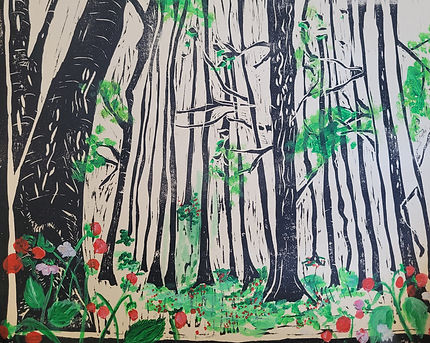
They ran, through the wood, following the goat’s trail until they came to a clearing. The children gasped when they saw the sight for the forest floor appeared like a richly woven carpet of red and green. All around were wild strawberry plants. Hundreds and hundreds. The goat was right in the middle contentedly munching away. The sun streamed through the trees. It was so inviting but the children hesitated. They had not forgotten the manners their grandmother had taught them. “Strawberries, sweet strawberries, thank you for your juicy berries.” They said then carefully they went into the clearing and sat to enjoy the delicious summer fruit. After eating so that they were full and their faces smeared with sticky, pink, they stopped. ‘Enough” the boy said.” His sister nodded, “Yes. We must leave some for the birds and animals. But what about Granny? She would love these!”
The boy nodded, “Let’s take her some!”
So very carefully, they gathered some strawberries holding them by the green leaves and runners so as not to crush the soft fruit. They caught the goat and they headed for home.
Their grandmother was delighted with the strawberries. She uttered a sentence of gratitude and then ate one, smiling as she savoured the sweetness. Then she took the others and showed the children the right place to plant them so that the green tendrils could take hold and grow. By and by their little garden was full of many new strawberry plants! There were so many they could all eat as many as they wished, including the goat and soon they had plentiful rich milk, spare strawberries to sell and even more to jam. And the old woman welcomed every Dawn and thanked every Day.
One morning a neighbour paid them a visit. This neighbour was not a kind man. He made a living counting tolls on the busy main road. He was known for his insistence that all tolls be paid in full with never any allowance or relief. On seeing the garden full of strawberries and the family comfortable and healthy, he enquired about the source of their new industry. The children happily told him about the clearing in the woods where they had found the wild strawberry patch. The neighbour’s eyes grew wide and his appetite and intention avaricious. With hardly a goodbye and no thanks of any sort, their neighbour, the tollkeeper, hurried as fast as he could from the cottage, straight towards the woods, heading for the place the children had described.
He trampled on through the wood swatting away insects and swiping at the brambles which scratched his ruddy skin. The sun shone and the tollkeeper sweated in his effort. He banged his head on a low branch and swore loudly. But when he reached the clearing he gasped in amazement. It was just as the children had said. The strawberry plants covered the ground stretching further even than when the children had visited. The tollkeeper grabbed at handfuls and stuffed his mouth, ripping the plants and spitting the stems. But this was not enough. The man was greedy and he knew that strawberries fetched a high price at the market.
He returned the next day with his wife and sons and with spades and sacks they dug up all the plants and the clearing was stripped and all was shadowy and silent.
Strawberries do not travel well in sacks. When they reached the market they opened them to find they had squashed and bruised and all that was left was a bloody mess.
But this tale does not end there. The children found the bare clearing where the strawberry patch had been and when they told their grandmother she bowed her head upon hearing of the sad waste. But Sun made a new day. The children and their grandmother took every other strawberry plant from their garden and walked to the wood. They stopped when the reached the clearing. The Grandmother and the children dug the plants back into the ground and then afterwards they sat together in the dappled sunlight and she offered some wise words which needed saying: “Thank you for sharing. Thank you for the berries we ate and the plants we grew. Here are some now for you.”
Story by Amelia Gledhill loosely based on the Somerset folktale, 'That's enough to Go On With' collected by Ruth Tongue, 1917 and published in, 'A Dictionary of British Folk Tales in the English Language' ed. Katherine Briggs (London: Routledge, 1970)
Original illustration © Sophie White, 2023 @sophiewhitestudios
‘That's Enough to Go On With’ © K. Amelia Gledhill 2023
The right of Amelia Gledhill to be identified as the author of this work has been asserted in accordance with the Copyright, Designs and Patents Act 1988
This is a work of fiction. All characters and events, other than those clearly in the public domain, are fictitious and any resemblance to real persons, living or dead, is purely coincidental.
All rights reserved. No part of this work may be reproduced without the prior permission in writing of the author.