Seasonal Stories of Soil, Sea, Sky, Home and Harmony
The Year Turn Fablist

English Folk Tales Retold

Story:
The Basket-Maker and his Donkey
A jocular tale
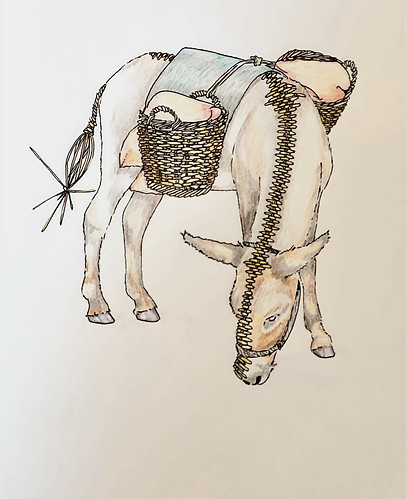
In the days of story, when the sun and the moon were friends and animals could talk, there lived a basket-maker and his donkey.
The basket-maker lived a simple life according to the slow rhythms of the reeds. He was a soft and quiet man but not so his donkey! Oh that donkey was a noisy one! He could chatter away- on and on! The donkey loved to gossip about neighbours, air lofty opinions and holey arguments of politics or philosophy and he told funny anecdotes and long stories of his youth. He didn’t take anything too seriously, laughing often with his big hee haw guffaw! Despite his nattering, the donkey worked diligently and uncomplainingly. With his ears pricked up, he would carry the basket-maker’s paniers of rods to and from the river bank and workshop. The basket-maker would smile, nod and murmur every now and again at the donkey’s conversation and continue about his day, working and weaving. In the evening they would rest together the basket maker smoothing and stroking the soft ears of the reeds and the donkey. The basket maker and his donkey were a happy pairing.
The basket-maker’s wife was not so content. She was always cranky and cross.
She had no time for the slow and unhurried craft. She would ask why could her husband not work quicker? Why did he spend time coppicing and planting cut reeds instead of using what was already growing? Why did he not cut in the first year? She asked why he waited until Michaelmas to cut and then stop cutting entirely at Candlemas? Why did he strip the bark or if he did not why did he insist on soaking the brown willow for such a long time? Why, she demanded, did he weave in complicated wicker and patterns instead of the quicker plain plaits and above all, how could he tolerate that braying, slow witted donkey?
But his was a skill and a temperament that could not be rushed and his baskets were beautiful and strong and famous in all the land. The donkey, with his one way conversation, was the company the quiet, introverted basket maker most enjoyed and the constant, “hee haw” became the cadence of his weave.
In the summer, when the basket-maker felt he had enough to take to the market fair, he loaded the donkey and set off. Their pace was unhurried and the basket-maker walked along the beautiful country lanes and foot tracks, half listening to the donkey’s nonsense but mostly listening for the buzz of the bees as they danced between the honeysuckle and the foxgloves and the twitter and song of the small birds in the branches and hedgeways. He noticed the butterflies as they swirled and flitted around in the breeze and enjoyed the warm sun on the back of his neck. He patted the donkey and smiled.
At the market, the basket-maker sat by his stall and whittled handle lines or shaved skeins; sometimes becoming so engrossed in his work, that he failed to notice potential customers.
At the end of the week’s fair, he had sold only a few baskets but content that he had enough money for his simple life and to replace any broken tools, he set off for home.
His wife was waiting at the door when they returned. She greeted her husband brusquely and then demanded to be shown the money he had made from the basket sales. At seeing the meagre sum, she flew into a rage.
“I will take this donkey back to market” she yelled, “I will sell more baskets -indeed all the baskets and I will sell this infuriating donkey too!”
She yanked on the donkey’s rope to lead him forward but the donkey resisted. He stood without moving, noisily protesting at her roughness, haste and vigour. In her anger, the woman picked up a withy of willow and whipped the poor donkey hard along his back.
The donkey split clean in two!
Aghast and upsett, the woman started to scream and wale. Without a second’s consideration, she took up her skirts and fled the scene as fast as her legs could carry her; never to be seen or heard from again!
The basket-maker, calm and careful as ever, picked up the two halves of the donkey and several rods of willow and started to weave him back together from crown to butt through ribrand belly and back.
When he was done, the donkey was whole again, recovered and regrown from the cut pieces. All that remained to show of the incident was a straight dark line down the center of his back where the two halves were joined.
From that day, the basket-maker and his donkey lived happily together, contented in their own company and slow pace of life.
Note: They're not spelling mistakes-
I've woven basket making terminology into the story!
BACK
This refers to the outward, convex curve of a willow rod
BUTT
This is the thick end of the willow rod where it is cut from the stool.
BELLY
This refers to the inward, concave curve of a willow rod
CRANKING
This is an essential technique used when creating side handles or when very tight turns need to be made with a willow rod
CROWN/CROWNING
This is the convex curve formed when making the basket base that adds strength and prevents the basket ‘bottoming out’ when weight is added to it
FOOT TRACK
This is an extra border worked on the base of the basket once the sides and top are completed.
PAIRING
This weave is done with two matched weavers that twist over and under the sticks or stakes of the basket.
PRICKING UP
This is when the stakes that have been inserted into the basket base are turned up vertically. It is done by pressing down with a bodkin or knife at the point at which the rod is to bend, as close as possible to the base.
A RIB RAND The first two or three strokes are worked over and/or under a varying number of uprights. For example; working over two, under two, over two, followed by the normal under one, over one. This creates a decorative spiral band in the basket.
UPSETT
The rows of weaving found where the stakes are turned up into the sides of the basket. They establish the flow. This is generally done with a waling weave.
WALING
This weave uses three rods at a time. They twist over and under the stakes to form a strong band. Rows of waling are usually found in the upset and just before the border.
When joining a new set of weavers they are usually added tips to tips or butt ends to butt ends to ensure an even weave.
Occasionally a four rod or even a five rod wale will be worked where strength is required particularly on the starting round of the upsett.
Source: https://www.basketryandbeyond.org.uk
Story by Amelia Gledhill loosely based on a Gypsy folktale collected by Dora E. Yates, "A Book of Gypsy Folk Tale" London: Phoenix House, 1948
Original illustration By Alex Gledhill
‘The Basket-Maker and his Donkey’ © K. Amelia Gledhill 2023
The right of Amelia Gledhill to be identified as the author of this work has been asserted in accordance with the Copyright, Designs and Patents Act 1988
This is a work of fiction. All characters and events, other than those clearly in the public domain, are fictitious and any resemblance to real persons, living or dead, is purely coincidental.
All rights reserved. No part of this work may be reproduced without the prior permission in writing of the author.