Seasonal Stories of Soil, Sea, Sky, Home and Harmony
The Year Turn Fablist

English Folk Tales Retold

Poem:
The Bride and The Cailleach
This story can begin at any point. You can read from now or later and you will end up in the same place again but never as quite the same person.
There is a fear of the female. It is other. Other than the obvious strength and dominance of male. She has been misunderstood, adored, oppressed and suppressed. But respected? Esteemed? Well her value should be treasured but has more often been worn as gaudy jewelry or buried altogether. But could she be destroyed? Not possible. She is the force of the world. The source of life. Hers is a power that sits at the root and blooms in beautiful generous bounty. And yet she is complicated, intricate, difficult. Hers is not one kind. She has more than one nature.
Welcome Spring. Here she is. The sun shines in pale streaks. The light falls on the bare trees revealing a new suppleness. Downy softness strokes their branches and blossom begins. Brigide wears a dress that flutters in the breeze. Her luminous skin and innocent expression beguile us. Anxiously, tentatively, she tiptoes on fragile grass, frost is still a close memory. She draws us to her. In gentle embrace we each soothe our fear and tiredness. Everything feels delicate but with whispers of intimate reassurance, she shares her plans and predictions. What generosity she has! We are valued and the reciprocity fills us with excitement. Together we can create new life! The possibilities burst in colour and we wonder together at the marvelous miracle of it all. Brigide is tender. She reaches out her hand and clasping, intertwining, we are safe.
Beautiful, confident Summer. Brigide is glowing. She stands at her full height. She is glorious. Of this she is aware and she revels in her magnificence. By the Oak tree, she sings, dances and laughs- surrounded by friends, lovers, admirers and she loves them all easily and with enthusiasm. The children too are drawn to her and climb into her arms. Brigide swings them, giddy with happiness and affection. In the summer Brigide’s love is competence and with a sunny capability, she is there to offer support and feed those who need her. She whirls, sure and barefoot through the long, lively days with boundless solar energy.
The shadows grow longer. Clouds and darkness threaten. Storms are likely. The leaves turn brown and crunch underfoot. The animals retreat. And people turn away from Brigide, the Cailleach. She no longer looks in the mirror and sees beauty, now her reflection is unsatisfactory. She sees and feels with overwhelming honesty. Spikes of conkers and prickles of bramble will scratch if you get too near or try to reach within. The forest’s branches are brittle and dry. They snap and may ignite and flare up. A fire rages. The rain comes in sobbing torrents. The light is gone. Brigide only wishes be taken seriously. Where once she would have had time for the sentiments and sorrows of others, now she demands to be listened to. She strains to be heard. There is no reasoning. She must tell you exactly how it is. How she knows it truly is, in its worst form. Any triviality or belittling enrages her and she transforms foul and frightening. Children run from her or delight in playing in the treat of flickering fear.
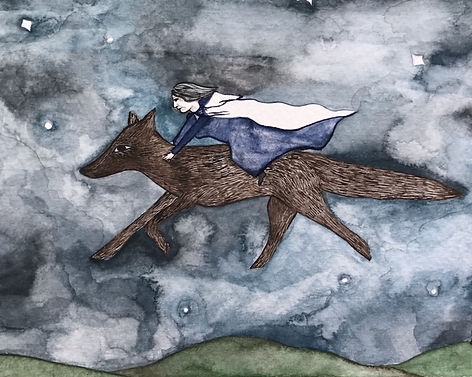
Exhausted, the Cailleach surrenders to the inevitable. She is tired. Wisdom is heavy and her hands and back are weak. It is cold. Her skin is blue and wrinkled. She retreats. Inside, she watches the snow fall from the grey sky. She wants no company. Slowly she moves through the days. She is still; she sleeps; she rests. The wolf shakes his thick coat and stretches. He howls. The soft padding of the wolf’s stealthy entrance is heard by no-one except the cailleach Brigide. She’s waiting, her own bare feet firm on the stone door step. The wolf and Brigide fly through the winter night. The stars and stones guide their way, steady and ancient. He drops her at the base of the great Oak. She stoops taking her time, gathering firewood. It is time to warm again. She will reignite and she will melt. She feels the quickening coming. Brigide bundles the wood and starts the journey home.
_________
Brigide (or The Bride) and the Cailleach are female figures from British mythology. They have been mostly interpreted as oppositional. The Cailleach hag is old, ugly and hateful and the personification of Winter. Brigide is the beautiful, innocent young maiden personifying Spring. The Cailleach rules through winter she is sometimes depicted as having blue skin and one eye and riding on a wolf. She carries a staff with which she hammers the ground causing it to freeze. She collects enough firewood to see herself through the winter but when she can bare it no longer she drinks from the magic well and transforms into a young maiden ushering in the Spring. The specifics and story of Brigide and the Cailleach may be unique to Britain but these two female archetypes are found in mythology and folk tale around the world. They show up in many a Disney movie!
The young maid, as the epitome of goodness, is a reduction, a one dimensional characterisation of femininity from the values of the Western mainstream patriarchal worldview. She is both young, naive, sexual, fragile, needing of reassurance and maternal, capable of running a household and multitasking. She is friends with animals but only the cute fluffy ones not the dangerous predators. She is garlanded in flowers but not knowledgeable in regards to bitter herbs. She is selfless and uncomplaining in caring and boundless in her love for family.
These are all the things our patriarchal world view attributes as archetypically female – ‘Brigide’ is their perfect woman.
By contrast, the Cailleach is articulated as old, unattractive, bitter and jealous. Her wisdom is 'witchcraft', she is selfish, nagging, frightening to children, withdrawn and reclusive and associated with the harsh cold of Winter and the secretive shadows of night not the bright, obvious illumination of day.
However, it important to deconstruct this characterisation. Having ‘Brigide’ as the standard that is held up to all women as the ideal, has been so pervasive and powerfully encoded into our society, that women themselves have started to believe that it is indeed preferable. More than that, it has become a myth of normal to the extent that women are expected to be this ‘Bride’ consistently and constantly. No wonder women are often tangled in a net of exhaustion, self loathing and guilt and the more complex aspects of the feminine including the withdrawn or fiery phases of the menstrual cycle, any expressions of justified outrage and experiences of aging have been supressed, hidden, often shrouded in shame and pathologized as a catalogue of medical symptoms.
However, it is possible to reinterpret the old fashioned, negative, misogynistic language and reframe the same traits from a positive Feminine point of view. The Cailleach can be beautiful with a self awareness of appearance that does not require her to be sexually attractive or young. She can be secure and proud of younger women- a role model- without being jealous. The Cailleach can be demanding and determined. She can hold you to account. She can handle direct, critical confrontation with the unsatisfactory, unjust and painful. She has the wisdom to offer solutions but does not always need to be available as a carer. Self care and reflection are also important to her. She is honest enough to embrace occasional fragility and uncertainty and ask for support. When we shift perspective in this way, we are able to maintain the association with Winter and see it as a necessary season of power, severity, clarity, serenity and beauty.
I want to claim that the Bride and the Cailleach are intrinsic components of every woman. And although true that these characters are a functional metaphor for the change that occurs as women physically age, from naivety of the Bride through to the confidence and wisdom of the Cailleach, importantly, the feminine complexity is that it is not simply a linear graduation from one to the other. A menstruating person experiences incarnation of all traits of the Bride and the Cailleach in the course of one menstrual cycle. Women are at once Bride then Cailleach over and over – cycling through the seasons on a spiral trajectory from menarche to menopause gathering wisdom and power.
With these roles reframed, we can all work to accept, perpetuate and support these wholesome, complete versions of the Feminine. We need to permit the Feminine inconsistency for the benefit of the individual and for society. We can all embrace the power, complexity and subtle nuance of the Cailleach as well as enjoying- without exulting or exhausting- the easy to love, generous Bride.