Seasonal Stories of Soil, Sea, Sky, Home and Harmony
The Year Turn Fablist

English Folk Tales Retold

Story:
The Baker's Daughter
A cautionary tale
The baker liked to talk about his arrival in the town. What he left, he never described. “Nobody knew who I was!” he would say, “I was unknown even to myself!” Then with rounds of drinks poured, he would describe how he had strolled into the square one summer morning, “For I was always up with the birds singing merry laylum!” and he would recall his very first tour of the town – mentioning each of his listener’s family homes as he mapped his walk; the butcher, the cobbler, the cartwright’s barn with its trailing roses, “Even this public house, I passed, searching as I was for bread. For I was as hungry as a new calf!” and then he would describe to his drinking companions how he found the bakery in a state of disrepair. “The old baker had gone run off with the miller’s wife apparently and left a right mess.” Reliably, this statement was accompanied with a grave nodding from all especially the miller himself. And the baker would wait for the only permitted interruption – a chorus of, “Better off without her!”, “Pasty faced wench”, “You’re alright now though eh”, and a wink from the miller as he received the back slapping kindness and gave a shy smile as he thought of his new life with the Widow Smith, living together as they had been for many years with acceptance and the townsfolk’s compassion. Then the baker would resume his tale of how he had settled to take over the bakery. And how with hours of hard graft and toil, sleepless nights and early mornings, the loans, the trust and the kindness of neighbours, he had fired the ovens and the smell of fresh bread had wafted thought the cobbled streets once more. And with each retelling, he sprinkled in a new anecdote, a funny snippet of an error made in his early days or reminisces of his customers- like the well loved but long deceased vicar who always asked for his bread sliced from top to bottom. Always at the end of the tale, the baker called for all the glasses to be filled as a gesture of gratitude, for without his neighbours, he insisted, he would still be lost and hungry. Then the baker would stand and make his good byes much earlier than the last orders were called. He would leave his friends as they began to sway and slur and he would make quick step home to sleep soundly next to his beloved wife with her soft doughy body in their warm bed.
In the morning, the baker would rise even before most were done with the night before, and he would tie his apron , flour his hands and set to work. As he began, the door would ring and in would come his daughter. The baker and his wife had always adored their daughter. She wanted for nothing. As a child her hair was tied with the prettiest ribbons; they fed her treats of sticky buns and cake and gave her dolls and books and even a pair of skates. At first they had said no to the skates but as her smile began to twist into a scowl, they had hastily relented and even though she had only worn them once, it made them happy to give her gifts. She had grown into a haughty, conceited young woman concerned with her appearance and standing.
The baker and his wife worked diligently in the bakery. They never asked for their daughter to help in the morning but she always came and worked. She stirred and kneaded, she swept the floors and swatted the flies. She served all of the customers reaching behind her for bread and buns, rolls and cobs slicing the bread with care. But where she worked hardest was with the accounts. The ledgers she kept showed neat rows of costs and profits. The baker’s daughter ordered courser, cheaper flour and sold it at higher prices, she sprinkled less sugar on the buns and portioned the rolls smaller. Demand for bread was always high so there was no need for penny-pinching but the daughter’s parsimony meant the family became wealthy. The only argument she had with her father was when she asked him about his tavern bills. “Why do you insist on buying rounds of drinks for the drunken folks in the bar?” she demanded. “With the money you spend on them, you could buy yourself a new suit every season.” But on this one issue the baker refused to give in to his daughter. “What need have I of new suits?” he would reply, “But when I was in real need, it was those same folks in the bar who set me straight.”
The baker’s daughter prided herself on being able tell what sort of person someone was from their orders. She smiled a syrupy good morning to those who came in fine clothes and ordered fruitbread and pastries. She sneered a thin lipped greeting to those who counted out payment in pennies. Every Christmas she obsequiously sent a gift basket of plaited loaves to the big house. The baker’s daughter knew who was who and what they had and she treated everyone as she thought they deserved.
One morning an old woman came to the bakery. She was dressed in tatters with billowing ragged sleeves and shuffled in boots which gaped as the sole flapped away from the heel. In the doorway, the old woman looked up at the baker’s daughter with yellowed eyes, and mumbled “I beg a piece of bread.” Disgusted, the baker’s daughter pushed the broom towards the threshold, puffing up a cloud of flour. The begger woman coughed as the falling white flour dust floated in the shaft of sunlight. “Out. I’ll have no begging here,” spat the baker’s daughter, “You will drive away my paying customers who will be offended by the sight and smell of you. Out!”
Hearing the raised voice of his daughter, the baker came into the shop. He glanced at the old woman who now sat forlorn on the cobblestones outside the bakery and then looked over his glasses at his daughter. Filled with disappointment and shame, the baker realized his daughter did not understand the privilege she had.
The baker tilted his head, “Does she not deserve our kindness?” he asked.
“Oh very well” the daughter huffed. “ You are as soft as one of your loaves! I only do this for you Father. This old woman has no money to pay for this bread. She has not had the forethought to save for old age. Probably did not work hard enough or maybe had too many mouths to feed or maybe she spent any money she had on cheap liquor!” Then, the baker’s daughter tore of a small handful of dough from the mound and placed it in the oven.
When the baker’s daughter went to the oven to retrieve the bread, it had risen beautifully and had a delicious looking golden brown crust. “I will not waste this loaf on that old hag,” thought the baker’s daughter, “No, I will save this to sell to someone else” Looking around to check that her father was out of sight, she took a much smaller piece of dough from the mound and placed it in the oven.
After a while, the daughter went again to the oven. When she opened the door, she was taken with surprise. Inside was a much larger loaf than the previous one. Again, the baker’s daughter decided against giving it to the beggarwoman and instead placed it on the shelf to sell.
Again she went to the mound but this time, she pulled a tiny pinch of dough. It really was so small that she could roll it in her palm with one finger. She placed it in the oven then went back to checking over her book-keeping. Suddenly there was a loud bang and a crash. The baker’s daughter hurried to where the noise had come from. The bread had risen to such an extent that it had burst out of the oven forcing the heavy door off its hinge. The huge loaf had an even, caramel sheen, it was perfectly cob shaped and it smelled delicious. The baker’s daughter stared in astonishment. Then the girl’s eyes grew wide and round with greed as she thought how much she could sell this loaf for. The old woman entered the room. “Oh go away” said the baker’s daughter, “Can’t you see I am too busy to give you anything?”
But as she went to walk away, she felt the old woman’s stick tap her on the shoulder. The baker’s daughter turned and she saw the beggar woman begin to transform. The rags turned into a beautiful silk dress and she started to glow.
“Who, who are you?” the baker’s daughter stammered. Her eyes now wide with fright and her face white with fear.
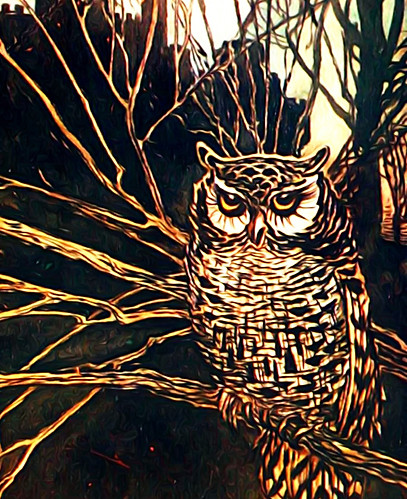
“Who who? Ha! That’s all you’ve ever cared about and now that’s all you’ll ever say ever again” the old woman cackled. And the baker’s daughter turned into an owl and flew right out of the door.
Sometimes very early in the morning, just as the bakers are starting work, if you listen carefully, you may hear the voice of the baker’s daughter… “Who Who?”
Story by Amelia Gledhill based on a Herefordshire folktale summarised in Dictionary of British Folk Tales in the English Language' ed. Katherine Briggs (London: Routledge, 1970)
‘The Baker's Daughter" © K. Amelia Gledhill 2023
The right of Amelia Gledhill to be identified as the author of this work has been asserted in accordance with the Copyright, Designs and Patents Act 1988
This is a work of fiction. All characters and events, other than those clearly in the public domain, are fictitious and any resemblance to real persons, living or dead, is purely coincidental.
All rights reserved. No part of this work may be reproduced without the prior permission in writing of the author.